Data-Driven Wake Modeling
日本語版: Data-Driven Wake Modeling (JP)
Wind Turbine Wake Modeling
In wind power generation, large amounts of electricity are often supplied by wind farms, where many turbines are installed in regions with strong wind resources. However, when multiple turbines are arranged in a row, downstream turbines are affected by the wakes generated by upstream turbines. As a result, disturbed inflow and wake interference between turbines can reduce the actual power output below the designed level. For this reason, turbine layout optimization and operational control are important issues in wind-farm design. To understand this problem, it is necessary to investigate in detail what kind of flow structures appear behind turbines. However, high-fidelity simulation of flows around wind turbines requires very large computational resources, and even with current supercomputers it is not realistic to directly simulate an entire wind farm at full fidelity.
For this reason, engineering wake models, which are simplified mathematical models that approximately represent wake velocity distributions, have traditionally been used. These models are very fast to evaluate, but they also have important limitations, such as restricted applicability and insufficient accuracy in representing wake interaction between turbines.
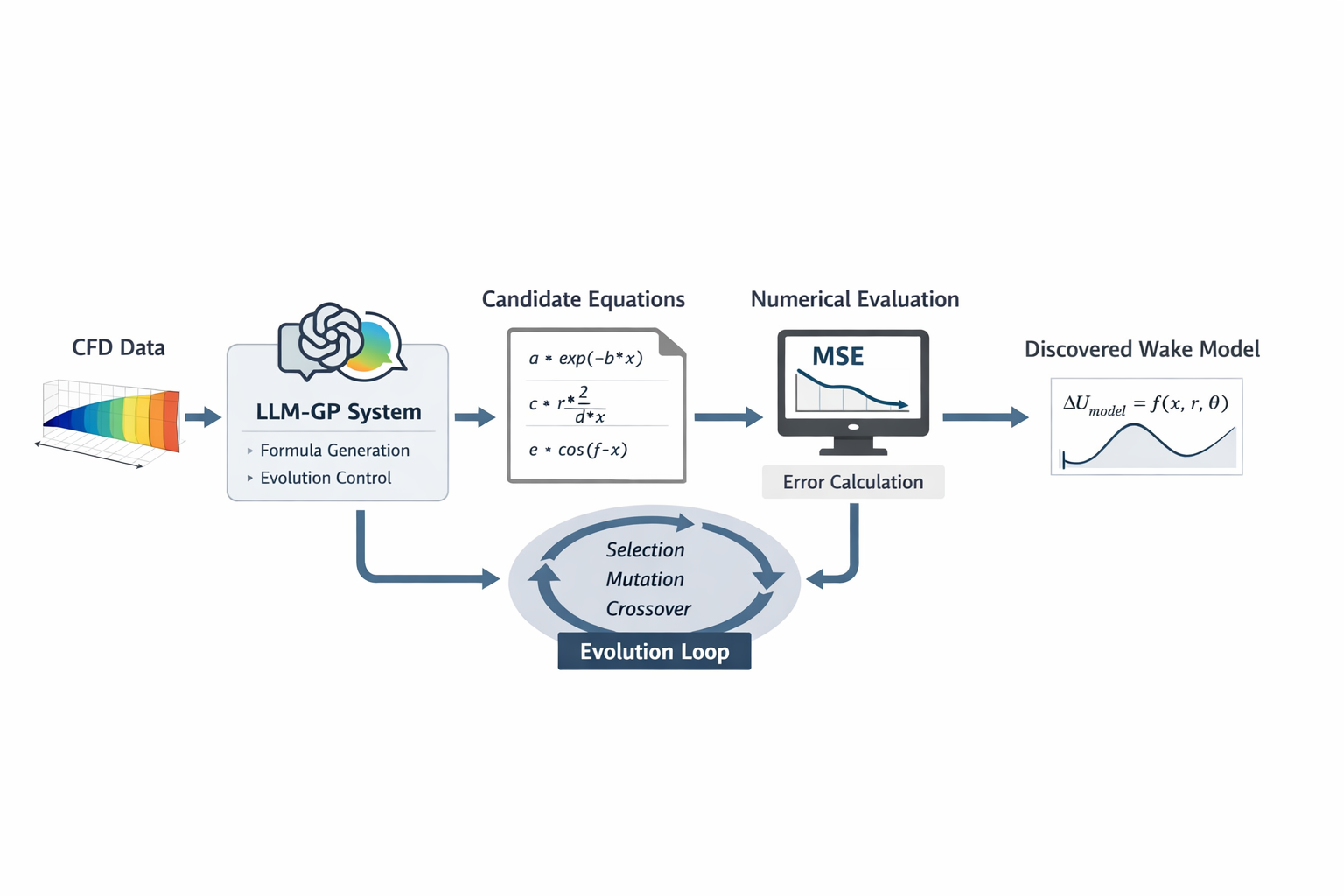
In this research, we applied LLM-GP, a method that combines large language models with evolutionary computation, to search for surrogate models that can replace conventional engineering models with higher accuracy and broader applicability. As a result, we were able to discover models with performance comparable to existing engineering models in a shorter search time than conventional genetic programming (GP). Furthermore, when this approach was applied to wake modeling for two turbines, it identified a model more effective than the widely used linear superposition model.
Key Publications
- Kenji Ono, Kanae Shiragami, and Kosuke Ureshino, An LLM-driven evolutionary computation framework, The 31st Conference on Computational Engineering and Science, 2026.