3D-IC Thermal Design
日本語版: 3D-IC Thermal Design (JP)
Thermal Design of Semiconductor Chips
With the rapid development of AI and high-performance computing, semiconductor chips are now required to achieve both higher performance and lower power consumption. One promising solution is the three-dimensional integrated circuit (3D-IC), in which chips are stacked vertically. However, stacking chips increases internal heat density and can create localized high-temperature regions, or hot spots, which lead to performance degradation and reduced device lifetime. To address this issue, it is important to predict the temperature distribution inside the chip from the early design stage and optimize placement and cooling structures accordingly. Conventional simulation, however, is computationally expensive, making it difficult to evaluate many design patterns during development. In addition, simplified models often cannot reproduce complex material structures or localized heat generation with sufficient accuracy.
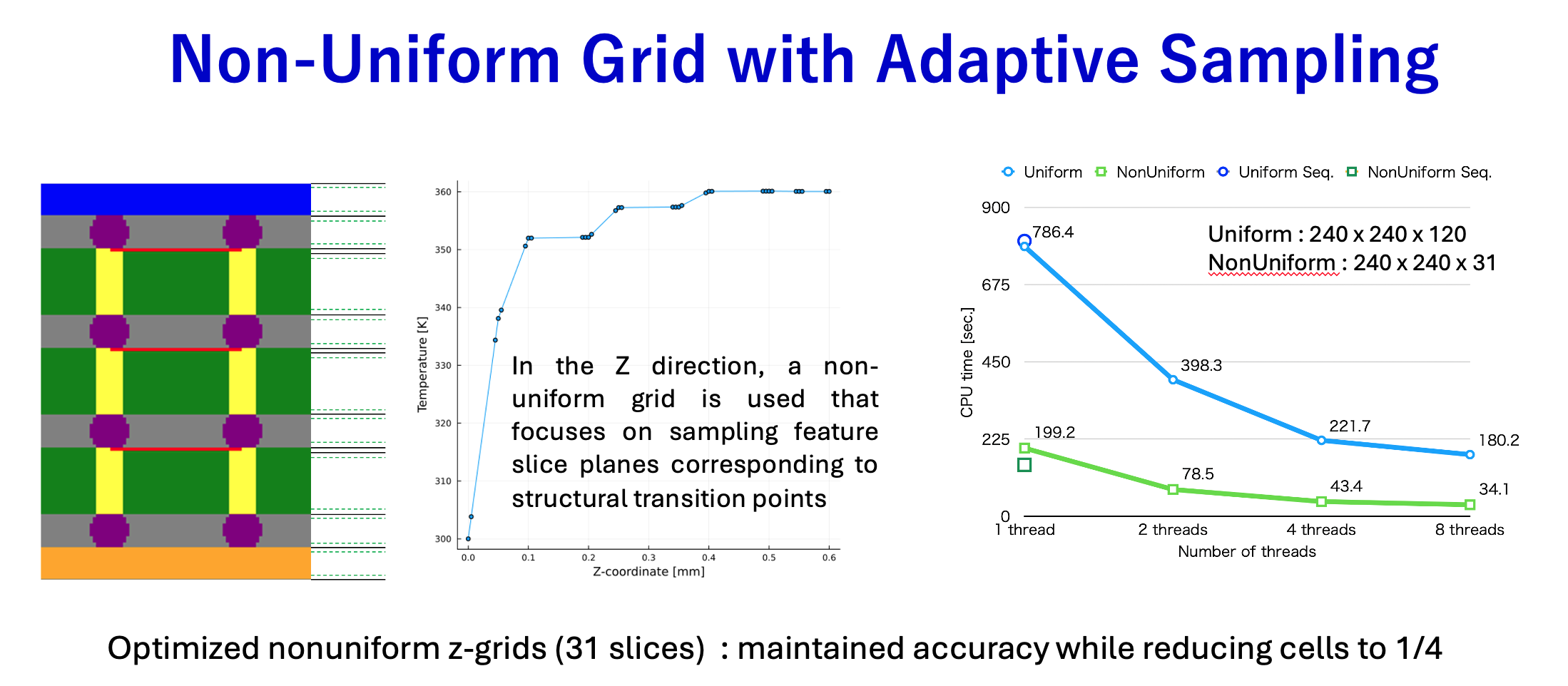
In this research, we developed a thermal analysis system capable of computing temperature distributions both quickly and accurately. The chip structure is generated automatically as a combination of basic geometric components such as cuboids and cylinders, and the heat conduction equation is solved efficiently using a tailored numerical method. In addition, the computational grid is optimized according to the stacked-layer structure, which significantly reduces the computational cost.
As a result, the proposed method achieved up to about 40 times faster performance than conventional uniform-grid approaches, and demonstrated that the temperature distribution of an entire chip can be computed within a few seconds on a standard laptop PC. This enables rapid evaluation of design parameters such as chip placement, power distribution, and cooling conditions, making thermal exploration in the early stage of semiconductor design practical.
This work contributes not only to higher-performance semiconductor systems, but also to improved energy efficiency in data centers and AI computing. Based on this high-throughput physical simulation framework, we plan to extend the approach toward next-generation semiconductor design support combined with machine learning.
Key Publications
- Kenji Ono, Takanori Iwasaki, and Takeshi Ohkawa, High-Throughput Thermal Simulation for Early-Stage 3D-IC Design Using Automated Meshing and Pseudo-3D Modeling, 2025 20th International Microsystems, Packaging, Assembly and Circuits Technology Conference (IMPACT), https://www.impact.org.tw/site/page.aspx?pid=901&sid=1283&lang=en, 2025.